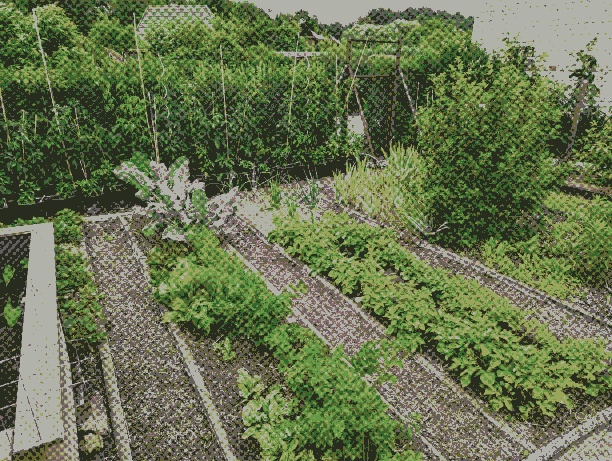
I've loved growing plants for years and have done so in various settings. I remember my first experiment of growing tomatoes in pots on the balcony was not really successful. Though things literally grew from there. Two years later every free space of my balcony was used up with grow bags, pots or beds I had built myself. But it is never enough! A few years later I got the chance to take over a garden outside of Berlin and that radically increased my available space. Since then I have mostly switched from "urban" balcony gardening to a more traditional garden. The available space has definitely made more things possible, but it was also really nice having your garden literally in front of your kitchen. Sometimes constraints like lack of available space force you to be creative and I really like the challenge of that constraint. And there is something delightfully absurd to be able to grab a bunch of potatoes or a squash from your balcony. I don't regret the "upgrade", but the increased space has made time the congested resource, which is a more frustrating constraint. Though learning to not just do something, but do it consistently and in a time-efficient manner is a good challenge.
Harvest
In 2021 I started keeping very detailed records of what I grew and how much I harvested. However, there have been some problems with the data, such as inconsistency and incompleteness. The way I've recorded the data has varied a lot, from scribbling notes on scraps of paper to using digital notes to entering structured data in a form. Another, more mundane problem that is also much harder to fix is that it's hard to resist snacking on fresh fruits or vegetables while walking around the garden. This leads to under reporting of anything that can be eaten with a bite or two.
| Plant | 2021 | 2022 | 2023 | 2024 | 2025 |
|---|---|---|---|---|---|
| Total | 24.155g | 78.938g | 101.448g | 144.056g | 150.157g |
| Apple | 0g | 2.790g | 5.868g | 133g | 1.447g |
| Asian lettuce | 200g | 0g | 369g | 931g | 575g |
| Basil | 0g | 0g | 87g | 281g | 1.478g |
| Basilikum | 0g | 0g | 0g | 0g | 130g |
| Bush bean | 200g | 1.446g | 690g | 2.065g | 0g |
| Yellow beet | 0g | 850g | 0g | 0g | 4.095g |
| Red beet | 305g | 1.420g | 1.899g | 1.894g | 5.318g |
| Broccoli | 1.630g | 130g | 4.449g | 4.571g | 1.725g |
| Blueberries | 0g | 0g | 41g | 0g | 0g |
| Savory (herb) | 0g | 0g | 0g | 0g | 43g |
| Pole bean | 0g | 0g | 0g | 2.262g | 1.358g |
| Blackberry | 0g | 0g | 0g | 26g | 0g |
| Bell pepper | 420g | 6.823g | 6.579g | 10.613g | 7.129g |
| Chinese cabbage | 400g | 5.955g | 5.233g | 0g | 0g |
| Strawberries | 0g | 0g | 2.940g | 0g | 1.207g |
| Corn salad | 200g | 0g | 20g | 0g | 270g |
| Kale | 0g | 130g | 858g | 120g | 75g |
| Cucumber melon | 0g | 0g | 0g | 0g | 46g |
| Currant | 0g | 2.967g | 6.047g | 1.369g | 3.480g |
| Garlic | 0g | 43g | 241g | 576g | 1.395g |
| Kohlrabi | 0g | 0g | 2.900g | 2.332g | 486g |
| Celeriac | 0g | 0g | 334g | 0g | 0g |
| Potato | 0g | 10.320g | 7.493g | 14.371g | 11.210g |
| Pumpkin | 1.270g | 6.822g | 14.248g | 41.527g | 50.189g |
| Leek | 0g | 200g | 0g | 0g | 0g |
| Melon | 0g | 0g | 0g | 0g | 279g |
| Swiss chard | 585g | 1.000g | 4.803g | 9.686g | 3.742g |
| Carrot | 0g | 0g | 2.484g | 1.982g | 4.491g |
| Mint | 0g | 120g | 0g | 0g | 0g |
| Obagine | 310g | 2.390g | 2.325g | 834g | 1.234g |
| Okra | 0g | 0g | 0g | 319g | 0g |
| Oregano | 0g | 60g | 0g | 0g | 0g |
| Parsnips | 0g | 0g | 3.091g | 0g | 1.065g |
| Puff Bohne | 0g | 0g | 0g | 0g | 356g |
| Bok choy | 0g | 0g | 145g | 0g | 3.385g |
| Physalis | 0g | 693g | 0g | 17g | 7g |
| Parsley | 0g | 0g | 0g | 0g | 323g |
| Radish | 120g | 922g | 132g | 536g | 610g |
| Radicchio | 0g | 0g | 823g | 823g | 0g |
| Rhubarb | 0g | 0g | 0g | 758g | 1.174g |
| Rosemary | 0g | 14g | 0g | 0g | 0g |
| Rettich | 0g | 0g | 0g | 0g | 3.682g |
| Arugula | 0g | 0g | 0g | 1.357g | 0g |
| Lettuce | 200g | 0g | 0g | 1.556g | 1.231g |
| Schalerbse | 0g | 0g | 0g | 0g | 236g |
| Salad cucumber | 0g | 2.634g | 612g | 2.767g | 1.379g |
| Chives | 0g | 24g | 0g | 78g | 0g |
| Spinach | 900g | 30g | 200g | 1.566g | 858g |
| Tomato | 16.395g | 16.853g | 9.492g | 8.778g | 7.145g |
| Jerusalem artichoke | 0g | 0g | 1.200g | 7.730g | 0g |
| Tomatillo | 0g | 0g | 272g | 1.559g | 148g |
| Wirsingkohl | 0g | 0g | 0g | 0g | 119g |
| Weintraube | 0g | 0g | 0g | 116g | 351g |
| Winter onion | 0g | 120g | 490g | 995g | 649g |
| Zucchini | 750g | 13.640g | 9.304g | 12.954g | 17.878g |
| Sugar peas | 270g | 542g | 490g | 0g | 0g |
| Sweet corn | 0g | 0g | 1.094g | 2.724g | 772g |
| Popcornmais | 0g | 0g | 0g | 0g | 687g |
| Flour corn | 0g | 0g | 0g | 346g | 0g |
| Onion | 0g | 0g | 4.195g | 3.504g | 6.700g |
Self-Sufficiency?
Tracking harvest data is not only fun for me, it helps me to answer various questions that pop into my head. Recently, I was wondering how close I am to only living off food I grow myself. While this is not something I aim for, it provides a good sense of the scale of hobby food production. Following Vaclav Smil's approach of reasoning about these questions in terms of energetic quantities, I decided to use the number of ingested vs produced calories as a proxy. Since I already track the weight of my harvests I can easily calculate the calories of my harvest. Of course there are significant seasonality effects, but assuming perfect storage of my harvest this should provide a good approximation. According to my tracking I consume on average at least 500 kcal more per day than the average sedentary male, so for me the minimum number of calories I need to ingest each day is 3000. Converting the harvests into calories is straightforward in theory, but estimates of caloric content for various vegetables can vary a lot depending on the source of the data. I also expect that the weather conditions greatly influence the caloric content in certain vegetables, and specially fruits, since the sugar content highly depends on high enough temperatures to develop through ripening.
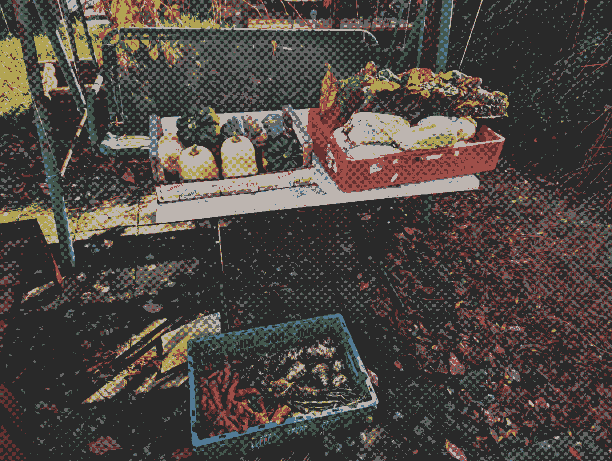
These disclaimers aside, in 2021 I grew 24 kg of produce, the majority of that tomatoes, pumpkin, squash and broccoli. However this only resulted in 5,456 kcal which is equivalent to sustaining myself for 1.81 days. In mid 2022 I was able to acquire some additional growing space, which increased the production to 72 kg of produce. The biggest contributors to that were 7 kg of potatoes since they are both high yielding and relatively high in caloric density. Even though I tripled my production that still amounts to only sustaining myself for 8.81 days. In 2023 I expanded the growing space with a new bed but focused a lot more on growing low-maintenance staple crops like pumpkins, carrots and parsnip. Generally it was a really bad year for tomatoes with a really low yield of 9 kg (-7 kg) and that with way more plants than the previous year. In the end it was about 101 kg of produce, which ends up at 38,669 kcal, or 12.88 days. In 2024 I expanded the growing space even more, building a trellis for my tomatoes. Since these beds were ornamental before, I did not directly plant the tomatoes in the new beds but still grew them in grow bags and covered the ground with cardboard. This worked pretty well and most tomatoes eventually rooted through the grow bag into the soil beneath. In the end my tomato harvest was once again really small, but it was an especially bad year with fungal diseases and I'm not growing resist varieties. The pumpkin harvest was really exceptional with over 41kg of pumpkins alone. Especially the variety "Muskat" had a great year and I baked a pumpkin pie many weeks in a row. For 2024 that makes a total yield of 144kg at 51,210 kcal, or 17.01 days. I managed to grow my total yield in 2025 again to 150kg (+6kg). The big winners were beets (red and yellow) and I pickled quite a few of them and made some great Borscht. It wasn't a great potato year for me, but pumpkins were really strong again (+3kg) mostly making up for that. I did well with onions and garlic this year, extending my _Allium_ self-sufficiency well into 2026. Overall calories were a little bit less, which in the end resulted in only 16 days of self-sufficiency.
| Plant | kcal per 100g | 2021 | 2022 | 2023 | 2024 | 2025 |
|---|---|---|---|---|---|---|
| Apple | 52 | 0 kcal | 1.451 kcal | 3.051 kcal | 69 kcal | 752 kcal |
| Asian lettuce | 13 | 26 kcal | 0 kcal | 48 kcal | 121 kcal | 75 kcal |
| Basil | 23 | 0 kcal | 0 kcal | 20 kcal | 65 kcal | 340 kcal |
| Bush bean | 31 | 62 kcal | 448 kcal | 214 kcal | 640 kcal | 0 kcal |
| Yellow beet | 43 | 0 kcal | 366 kcal | 0 kcal | 0 kcal | 1.761 kcal |
| Red beet | 43 | 131 kcal | 611 kcal | 817 kcal | 814 kcal | 2.287 kcal |
| Broccoli | 55 | 897 kcal | 72 kcal | 2.447 kcal | 2.514 kcal | 949 kcal |
| Blueberries | 57 | 0 kcal | 0 kcal | 23 kcal | 0 kcal | 0 kcal |
| Pole bean | 31 | 0 kcal | 0 kcal | 0 kcal | 701 kcal | 421 kcal |
| Blackberry | 43 | 0 kcal | 0 kcal | 0 kcal | 11 kcal | 0 kcal |
| Savory (herb) | 43 | 0 kcal | 0 kcal | 0 kcal | 0 kcal | 18 kcal |
| Bell pepper | 31 | 130 kcal | 2.115 kcal | 2.039 kcal | 3.290 kcal | 2.210 kcal |
| Chinese cabbage | 13 | 52 kcal | 774 kcal | 680 kcal | 0 kcal | 0 kcal |
| Strawberries | 32 | 0 kcal | 0 kcal | 941 kcal | 0 kcal | 386 kcal |
| Corn salad | 17 | 34 kcal | 0 kcal | 3 kcal | 0 kcal | 46 kcal |
| Kale | 49 | 0 kcal | 64 kcal | 420 kcal | 59 kcal | 37 kcal |
| Cucumber melon | 24 | 0 kcal | 0 kcal | 0 kcal | 0 kcal | 11 kcal |
| Currant | 63 | 0 kcal | 1.869 kcal | 3.810 kcal | 862 kcal | 2.192 kcal |
| Garlic | 149 | 0 kcal | 64 kcal | 359 kcal | 858 kcal | 2.079 kcal |
| Kohlrabi | 27 | 0 kcal | 0 kcal | 783 kcal | 630 kcal | 131 kcal |
| Celeriac | 42 | 0 kcal | 0 kcal | 140 kcal | 0 kcal | 0 kcal |
| Potato | 77 | 0 kcal | 7.946 kcal | 5.770 kcal | 11.066 kcal | 8.632 kcal |
| Pumpkin | 26 | 330 kcal | 1.774 kcal | 3.704 kcal | 10.797 kcal | 13.049 kcal |
| Leek | 61 | 0 kcal | 122 kcal | 0 kcal | 0 kcal | 0 kcal |
| Melon | 34 | 0 kcal | 0 kcal | 0 kcal | 0 kcal | 95 kcal |
| Swiss chard | 19 | 111 kcal | 190 kcal | 913 kcal | 1.840 kcal | 711 kcal |
| Carrot | 41 | 0 kcal | 0 kcal | 1.018 kcal | 813 kcal | 1.841 kcal |
| Mint | 49 | 0 kcal | 59 kcal | 0 kcal | 0 kcal | 0 kcal |
| Obagine | 82 | 254 kcal | 1.960 kcal | 1.907 kcal | 684 kcal | 1.012 kcal |
| Oregano | 265 | 0 kcal | 159 kcal | 0 kcal | 0 kcal | 0 kcal |
| Parsnips | 75 | 0 kcal | 0 kcal | 2.318 kcal | 0 kcal | 799 kcal |
| Bok choy | 13 | 0 kcal | 0 kcal | 19 kcal | 0 kcal | 440 kcal |
| Physalis | 43 | 0 kcal | 298 kcal | 0 kcal | 7 kcal | 3 kcal |
| Parsley | 36 | 0 kcal | 0 kcal | 0 kcal | 0 kcal | 116 kcal |
| Radish | 16 | 19 kcal | 148 kcal | 21 kcal | 86 kcal | 98 kcal |
| Radicchio | 23 | 0 kcal | 0 kcal | 189 kcal | 189 kcal | 0 kcal |
| Rhubarb | 21 | 0 kcal | 0 kcal | 0 kcal | 159 kcal | 247 kcal |
| Rosemary | 131 | 0 kcal | 18 kcal | 0 kcal | 0 kcal | 0 kcal |
| Arugula | 25 | 0 kcal | 0 kcal | 0 kcal | 339 kcal | 0 kcal |
| Lettuce | 5 | 10 kcal | 0 kcal | 0 kcal | 78 kcal | 62 kcal |
| Salad cucumber | 12 | 0 kcal | 316 kcal | 73 kcal | 332 kcal | 165 kcal |
| Chives | 30 | 0 kcal | 7 kcal | 0 kcal | 23 kcal | 0 kcal |
| Spinach | 23 | 207 kcal | 7 kcal | 46 kcal | 360 kcal | 197 kcal |
| Tomato | 18 | 2.951 kcal | 3.034 kcal | 1.709 kcal | 1.580 kcal | 1.286 kcal |
| Jerusalem artichoke | 73 | 0 kcal | 0 kcal | 876 kcal | 5.643 kcal | 0 kcal |
| Tomatillo | 32 | 0 kcal | 0 kcal | 87 kcal | 499 kcal | 47 kcal |
| Winter onion | 31 | 0 kcal | 37 kcal | 152 kcal | 308 kcal | 201 kcal |
| Zucchini | 17 | 128 kcal | 2.319 kcal | 1.582 kcal | 2.202 kcal | 3.039 kcal |
| Sugar peas | 42 | 113 kcal | 228 kcal | 206 kcal | 0 kcal | 0 kcal |
| Sweet corn | 86 | 0 kcal | 0 kcal | 941 kcal | 2.343 kcal | 664 kcal |
| Onion | 32 | 0 kcal | 0 kcal | 1.342 kcal | 1.121 kcal | 2.144 kcal |
| Okra | 33 | 0 kcal | 0 kcal | 0 kcal | 105 kcal | 0 kcal |
| 5.456 kcal | 26.454 kcal | 38.669 kcal | 51.210 kcal | 48.543 kcal |
Season Notes
One interesting property of gardening is that it is so intimately bound to the passage of time. You can't rush a carrot, and you can't plant your tomatoes in December just because it is convenient for you (at least in our climate here). Things will happen when they happen. You need to accept that you only have so many seasons to grow in your lifetime, maybe 40 to 50 seasons. It is not that many tries for getting good at something, so we'll have to maximize our improvement in each season. That means each winter, I take some time to reflect on the season. These are some of my notes. I've not been great at actually writing them down, so this is my attempt to capture that for future me or whoever finds it useful.
2020
First year I tried to scale up the garden on the balcony. Really pitiful harvest of most things. However, it sent me down a rabbit hole to figure out how to change that. My general insight was: The size of the pots matters, and I need to do some planning.
2021
This was the first season I started taking records of planting times and some sporadic harvest records. I really extended the balcony garden, and naturally, soon there were lots of plants but not much balcony left. I also invested in building some sizable planters with a decent amount of soil. That really changed the kind of plants I could grow successfully. I learned many things that season:
- Every garden needs a compost.
- Consistent watering is key, and an automatic irrigation system is really helpful with that.
- There is such a thing as too much sun; shade cloth is your friend.
2022
This was probably one of the most chaotic and hectic years for many reasons. One of them was that I got the chance to take over a garden somewhere in Brandenburg mid-season (and if you haven't caught on by now: I was beyond excited). In addition to taking care of my garden at home, I suddenly had many more plants to take care of. Time became the limited resource, and the garden I took over was built to be labor-intensive: a lot of shrubs, flowers arranged in a pristine way, grass that had to be mowed, and lots of corners to weed. Suddenly, harvesting and planting was only a fraction of the time spent; most of it was upkeep. Watering alone usually took a good amount of time (45 minutes to an hour at least) lugging around the watering cans. I came out of that with a lot of interesting insights:
- Not all garden work is equally important. Know what has to be done and do that first.
- Invest in an irrigation system, especially if you can't be in the garden daily.
- The humble potato is an undervalued crop.
2023
This was the first full season in the garden and with that came ambition (and failure). The city climate spoiled me a little bit in terms of mild temperatures. This meant that I was a little overly optimistic on when I could bring my little seedlings to the great outdoors. In Berlin I did not see a frost after early May, though in Brandenburg the conventional wisdom of "not before May 15th" was pretty exact. On top of that it stayed pretty cold on average for quite a while. A fact my pepper plants did not appreciate at all. As a result I had some stressed seedlings, either because they grew too large for their pots or too cold. I grew over 20 pepper plants and 10 tomato plants, way more than the previous year in both cases. However my yield on peppers was almost the same as the previous year and my yield on tomatoes was almost half! Part of that was that the varieties I selected for the sheltered warm city climate were just not right for cold and moist weather. Quite a few tomato succumbed to diseases early on. Another reason was that I thought it was a great idea to cram as many tomatoes into the space as possible. Certainly this was an impulse from being space constrained from so long, but without proper airflow the increased humidity caused the fungi infections.
- A little swiss chard goes a long way. It can always grow faster than you can eating it without getting bored.
- Growing tomatoes in Brandenburg needs more care. Airflow is important, so are varieties.
- Earlier is not always better. Especially with the big plants like tomatoes and peppers you need to time it right.
- You really only need one zucchini plant.
- Sweet corn is great!
2024
I took all the insights from 2023 and did basically the same mistakes. Not quite, but I did manage to decrease my tomato yield even more. I improved the airflow a lot, but I did not see the early warning signs of blight or rather I did purposefully ignore it. Radical action is necessary but chopping down the infected plants was not something I wanted to do. Alas not all was bad, the peppers did produce a decent yield that year. I was also a lot happier with my continuous harvest of various high-production plants (zucchini, broccoli, green beans) and the increased quality of produce that resulted in. The potato harvest was really good and partially I attribute this to a completely automated irrigation and made sure they had optimal moisture. Unfortunately I did underestimate how vigorous the spuds grew. They pushed through the surface in many places, which resulted in a regretful amount of uneatable green potatoes.
- Take your time to hill your potatoes. Seed potato are nice, but I much rather want to eat them.
- Time to gear up with fungi resistant tomato plants. Goodbye heirlooms.
- Slugs eat pepper plants. Keep them safe.
- I need a green house. Or at least tarp the tomatoes in bad weather.
2025
I feel like a failing start-up CEO always promissing next year will be the year of the tomato harvest, but it never comes. Alas in 2025 I had the opportunity to help out a friend with his urban farm and that provied ample tomato yields, that are not accounted for here. It is insane how well tomatoes grow in a hydroponic system, the plants were super vigorous and healthy. I think we harvested at least 40kg of tomatoes from 5 plants. There are big plans for 2026 though: I'll finally invest in a real greenhouse. I salvaged a small foil greenhouse from my parents in 2025 but I mostly used it for the cucumbers since it wasn't super tall. There were some unfortunate issues with spidermites that I addressed way too late. I did have some time to fix all the water pipes though (finally!) and that has simplified the irrigation dramaticaly. Digging those trenches was definitely a good workout. At the tail end of 2025 I spend some time to clear up some additional beds for growing vegetables and removed ornamentals. This should give me enought space for 2026 to grow a decent amount of beans and corn, both of which store well. The potato harvest was pretty bad, because I sowed them too early. They came up beautifully but were brutally killed by a severe frost. They did resprout eventually but this effectively lost 2-3 weeks of growing time over just planting them at the right time.
- My seedlings were pretty weak because I overwatered and then tried to "fix" it (I assumed the yellowing was nutrient deficency) with fertilizer that had gone bad.
- Tastewise there is a world of difference between hydroponic and ground-grown tomatoes.
- Root vegetables need to cure in warm and dry conditions for a day before storing them, otherise they will rot easily.